Hello,
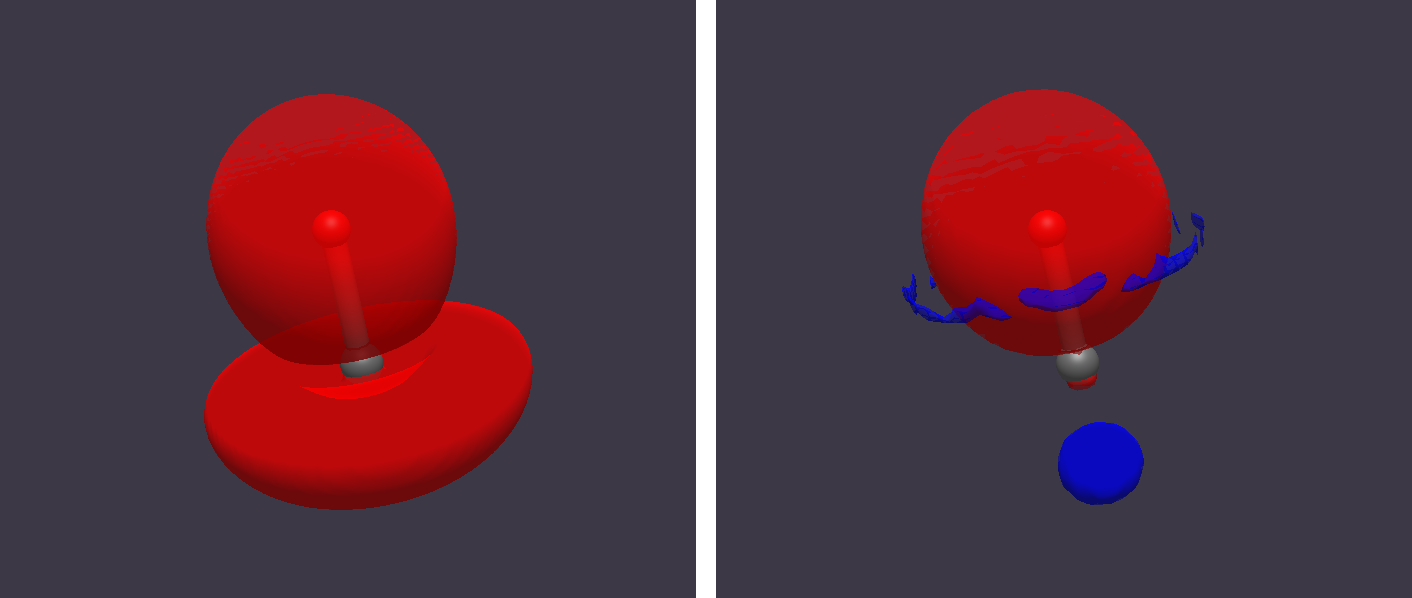
I’m quite new here., but a longtime fan of the software. I recently noticed that orbitals displayed directly from a Gaussian .fchk file in Avogadro2 do not always match the corresponding Gaussian cubegen orbital cube generated from the same .fchk (especially noticeable for small isovalues such as 0.0001).
A reproducible example is CO.
Gaussian input:
%chk=co.chk
%mem=4GB
%nprocshared=8
#p rhf/cc-pVDZ scf=tight

CO RHF/cc-pVDZ single-point

0 1
C   0.000000   0.000000   0.000000
O   0.000000   0.000000   1.128000
Then I run:
g16 < co.gjf > co.log
formchk co.chk co.fchk
cubegen 0 MO=1 co.fchk co_mo1.cube 0 h
What I compare:
-
open
co.fchkin Avogadro2 and Analyse → Create Surface → Molecular Orbital → MO 1 → Isosurface Value: 0.0001 → Calculate. -
open
co_mo1.cubein Avogadro2 and Analyse → Create Surface → From File → Cube 1 → Isosurface Value: 0.0001 → Calculate.
What I expected:
- these should match apart from a possible overall sign flip, since both should come from the same wavefunction and same orbital
What I observe:
-
the shape looks noticeably different
-
the discrepancy is much larger than expected from numerical issues.
-
I have also noticed similar behavior with other systems / basis sets with varying degrees of discrepancy.
For reference, I am attaching:
-
a screenshot of MO 1 shown directly from
co.fchk(left) -
a screenshot of
co_mo1.cubeshown at the same isovalue (right)
Avogadro Version: 2.0.0
So, I wanted to ask:
-
Is this expected?
-
Does Avogadro2 reconstruct orbitals from
.fchkdifferently from Gaussiancubegen? -
Or should these really match?
If needed, I can also provide the .fchk file or any other information needed.
Thanks.